
- Jul 14, 2025
Should You Title Your Brokerage Account in a Trust or Use a Transfer on Death (TOD)?
- Marla Landa
- Estate Planning
Join our Newsletter for More Good Stuff!
When it comes to estate planning, even small decisions like how you title your brokerage account can have a big impact. One of the most common questions we hear is:
"Should I put my brokerage account in my trust or use a Transfer on Death (TOD) designation?"
Both can help your loved ones avoid probate, but they work in different ways. Here's a breakdown to help you understand the pros and cons of each option, so you can choose what fits your goals best.
Trust vs. TOD: What is the Difference?
Titling Your Brokerage Account in a Trust
When you place a brokerage account in the name of your revocable living trust, you're aligning that account with your broader estate plan. This allows for more flexibility and control while you are alive and after you are gone.
Benefits:
* Avoids probate
* A successor trustee can step in if you become incapacitated
* Enables detailed instructions for how assets should be distributed (such as staggered gifts or ongoing trusts for children)
* Centralizes your assets within your estate plan for easier management
* Reduces the risk of conflict between heirs
Best for you if:
You already have a trust, have multiple or complex beneficiaries, or want more control over how your assets are managed and distributed. This is especially helpful if you are concerned about incapacity or want to include backup planning.
Using a TOD (Transfer on Death) Designation
A TOD designation is a simpler way to pass assets outside of probate. You name a beneficiary directly on the account, and when you pass away, the account goes straight to that person.
Benefits:
* Avoids probate
* Easy to set up
* Efficient for small or simple estates
Limitations:
* Only activates at death (not helpful if you become incapacitated)
* No flexibility for staggered or conditional distributions
* Not always ideal for multiple beneficiaries
Best for you if:
You have a smaller estate, are naming one or two trusted individuals, and are not concerned about how the funds are used after you pass.
Quick Comparison Chart
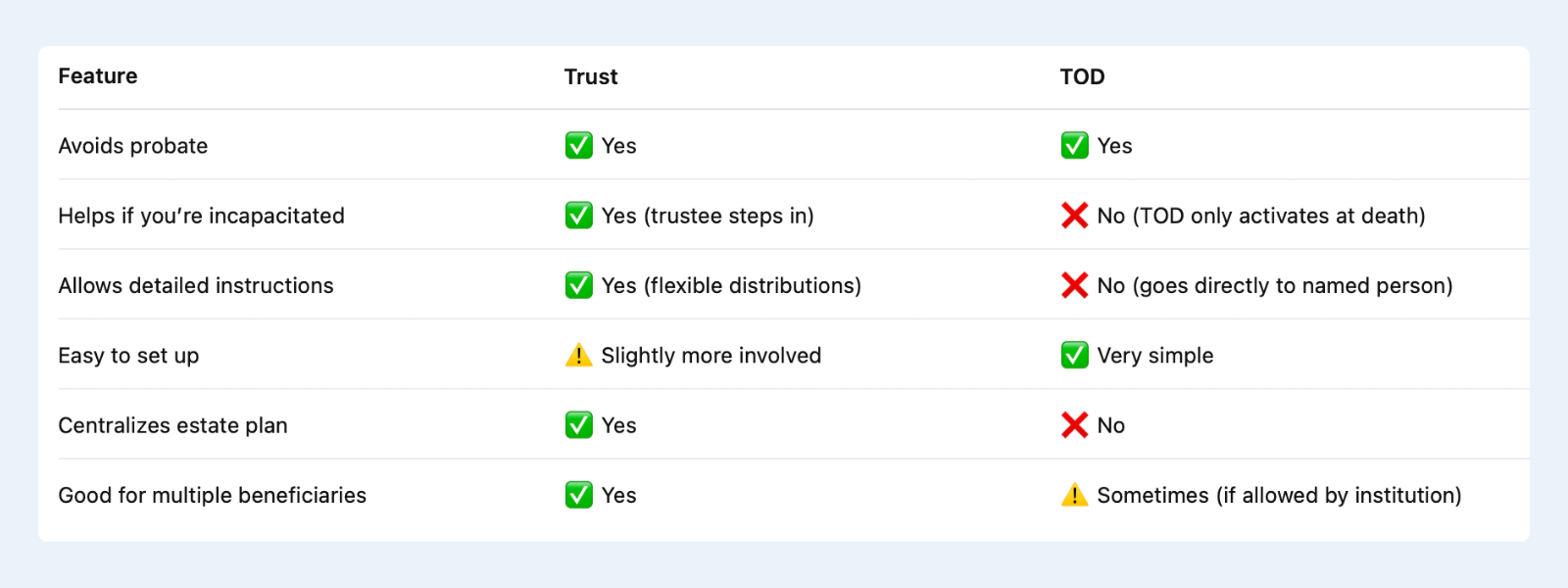
What is the Right Choice?
Use a Trust if:
* You already have one
* You want more control over how and when your assets are distributed
* You want your successor trustee to step in if you become incapacitated
* You have multiple beneficiaries or a more complex estate
Use TOD only if:
* Your estate is very simple
* You are not using a trust
* You are naming one or two trusted individuals
* You do not need detailed instructions for how the money is used
Common Questions
Can I do both a TOD and a Trust?
Technically yes, but be careful. The TOD designation overrides the trust for that account. So if your account is titled in your trust and you add a TOD beneficiary, the TOD takes priority. This can create conflicts with the rest of your estate plan. It is usually best to choose one method per account.
Will my Power of Attorney work on a TOD account?
Your Power of Attorney can manage a TOD account if you become incapacitated, but only while you are alive. After you pass, the account goes directly to the TOD beneficiary. If you want someone to manage the account during life and after death, a trust offers a smoother solution.
What About Taxes?
From a tax perspective, both trust-titled and TOD accounts receive a step-up in cost basis when the owner passes away. This means that capital gains are usually erased for the beneficiary, potentially reducing taxes when they sell the assets.
However, if you live in a community property state and the account is held jointly with your spouse, trust titling may offer a full step-up in basis for both halves of the account, not just the decedent's half.
It is important to note that tax treatment can vary based on the type of assets held, your state, and how your estate is structured. Always consult a qualified tax advisor for guidance.
Disclaimer: Our services do not include investment, tax, or legal advice unless provided through a Registered Investment Advisor under a separate Advisory Agreement.
Final Thoughts
Both a trust and a TOD can help avoid probate. The right option depends on your goals, the complexity of your estate, and how much control you want over timing, access, and structure.
If you already have a trust, it often makes sense to title your brokerage accounts in the name of your trust. If you do not have a trust and your plan is straightforward, a TOD can be a quick, effective alternative.
How Plan Forward Finance Can Help
We help you make estate planning decisions with clarity and confidence. Whether that means reviewing your account titles, updating beneficiaries, or figuring out how to align everything with your plan, you do not have to figure it out alone.
We will walk through your accounts together and help you take thoughtful, proactive steps that support your goals.
Schedule a free 30-minute Initial Planning Meeting to get started.
Thanks for reading!
Marla @ Plan Forward Finance